What to See on Sal – the Whole Island in Order, and What It Is Not
Updated September 24, 2026 · 8 min read
Most people arrive on Sal without having chosen it. Amílcar Cabral International Airport, two kilometres west-southwest of Espargos, is the main international airport of Cape Verde and was the only one in the country to take international flights until September 2005. It has the longest runway in the archipelago at 3,272 metres and handled 1,192,828 passengers in 2019. If you are flying to Cape Verde, there is a good chance you land here whether or not Sal was the plan.
That history explains the island’s odd shape as a destination. Sal is 219.84 km² of low, dry volcanic ground, 29.7 kilometres long and 11.8 kilometres wide, with its highest point at Monte Grande, 406 metres. It has around 39,700 residents and roughly 350 days of sunshine a year. It does not have the green ravines that appear in most photographs of Cape Verde. Those are on other islands, and no tour from here reaches them in a day.
What Sal does have is a handful of genuinely strange places, very reliable weather, and short distances. This is where they are.
Six settlements, and you will only use three
The island’s six named places are Espargos, Santa Maria, Palmeira, Pedra de Lume, Murdeira and Terra Boa. Espargos sits in the middle and is the municipal seat: the administrative town, the hospital, the market, the place buses leave from. Santa Maria is the resort town in the far south, where nearly all hotels are. Palmeira on the west coast is the working harbour.
Between the airport and Santa Maria there is about twenty minutes of road. That single number is worth more than a map, because it is why almost nothing on this island needs a whole day. How you cover those twenty minutes, and what it should cost, is the first decision you will make here.
The rest of the island is gravel, salt flats and wind. No further villages are hidden in it, and the emptiness is genuine rather than the kind that turns scenic around a corner.
Most visitors never leave Santa Maria, and that is a defensible holiday. If you do go north, Espargos is worth an hour rather than a morning: a market, painted walls, ordinary streets with no tourist infrastructure and no view. Going there is a decision to see how the island actually lives, which is a different thing from sightseeing, and it is best done on a weekday morning when the market is working.
The four sights that actually justify the drive
Pedra de Lume. A salt pan of about four hectares on the floor of an extinct volcanic crater, reached through a tunnel cut through the crater wall in the nineteenth century. The water is so saline that people float on it without effort. It has been a protected landscape since 2003 and went onto Cape Verde’s UNESCO tentative list in 2004. Entry is around €5 on its own. Two articles cover it from different angles: the sight and its opening hours, and what the floating is actually like.
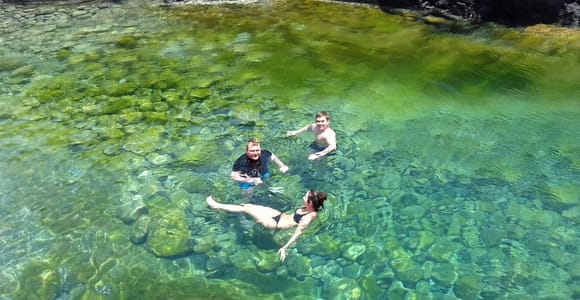
Buracona and the Blue Eye. A lava pool on the northwest coast where, for a narrow window each day, sunlight enters an underwater opening and lights the water from below. The window is the point, and missing it is the most common disappointment on this island. The timing is in the Blue Eye article.
Shark Bay. A shallow bay east of Santa Maria where juvenile lemon sharks come into knee-deep water. It is on almost every island tour, and there is a separate article about the season, the law and the one question to ask before booking it.
Terra Boa. A flat plain inland where the heat produces a mirage that looks like standing water. It is a five-minute stop, not a destination, and it is worth knowing that in advance.
Notice what is not on this list: Santa Maria’s beach. That is not a slight, it is a category difference. The beach is where you spend the afternoons, and which stretch of water is safe matters more there than any sight.
One loop, or pieces
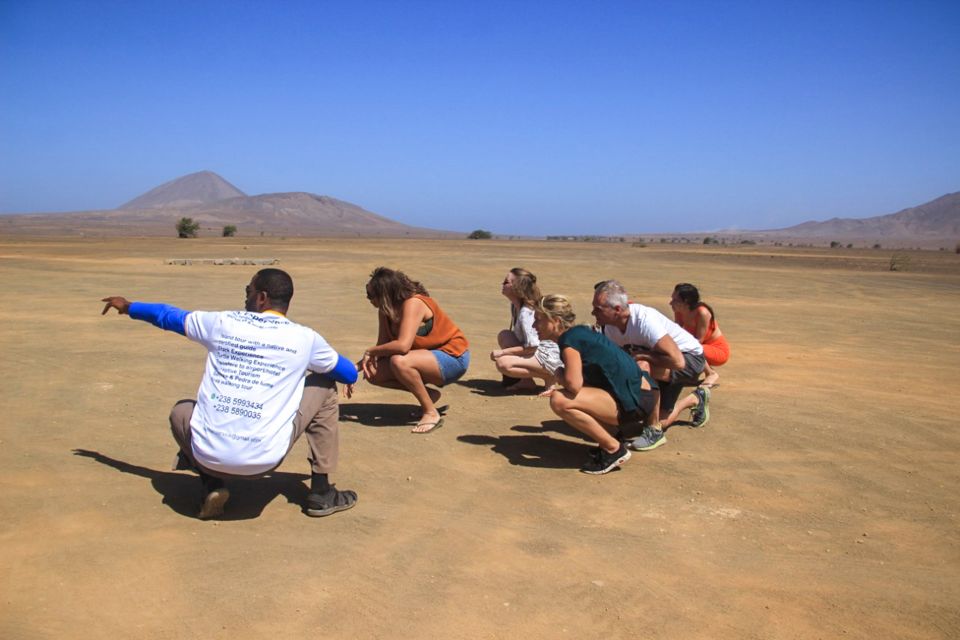
Every one of those four places sits on the same circuit, which is why the island tour is the dominant product here. There are 55 of them, from €27, and the differences are real:
- The most-reviewed option runs seven hours at €35 with a certified local guide, and 4,287 reviews at 4.8 stars is a great deal of evidence for one product.
- The all-inclusive four-hour version at €45 does Shark Bay, the salt lake and the Blue Eye and gets you back by lunch.
- The cheapest full circuit is €29 for six hours and adds Palmeira.
- A small-group version runs six hours at €35 for people who do not want a coach.
- The Murdeira nature reserve and fishing village tour at €43 is the one that strings Espargos, Palmeira, the Blue Eye and the salt lake together instead.
Doing it in pieces costs more in transport than it saves in tickets, and the Blue Eye’s light window is hard to hit without a driver who knows it. The one good argument for going independently is that you can sit at Pedra de Lume for two hours instead of forty minutes.
What this island does not have
Being clear about this is more useful than another list of highlights.
No mountains, no forest, no waterfalls. Sal is flat and arid. The rainy season runs from July to mid-October and even then rainfall is low.
Almost no shade. Not on the beach, not at the sights, not on the drive. This changes how long anything is bearable with children.
No lifeguards on the beach. Not reduced hours, none at all.
No ride-hailing apps. Taxis are not metered either, so the fare is agreed before you get in.
No farm-to-table scene. The island is arid and has almost no agriculture of its own. What it does have is cachupa, morna and a harbour at mid-morning, and that is its own article.
When to come, and what the wind decides
The sea averages about 24 °C across the year and the sun is close to constant, so the season is not really about temperature. It is about wind and animals.
The northeast trades are strongest in the winter half of the year, which is why the island has a real wind scene: 8 kitesurfing and windsurfing offers from €38 and a serious wave spot at Ponta Preta. The same wind makes an afternoon on a stand-up paddleboard harder work than a morning one. What the wind means for lessons is covered separately.
Turtles nest between roughly June and October, and that part of the year is regulated. If the turtles are the reason you are coming, the 20 turtle trips from €28 only make sense inside that window.
A first two days that works
Land, get to Santa Maria, and do nothing on the first afternoon except establish where the water is safe.
Day two, take the island loop early. You will see the four sights, understand the geography, and come back knowing which of them you want to return to slowly. Then pick by appetite rather than by list: quad and buggy routes from €29.99 for the inland tracks, catamaran and boat trips from €20 or snorkelling and diving from €28 for the reef and the wrecks, food and culture tours from €25 for Espargos and Palmeira, or the 38 land-based experiences from €25 for everything that fits none of those.
Across the whole island there are 133 bookable offers with a median price of €52. That is a small catalogue, and it is the honest reason this island rewards two good choices more than a packed schedule.